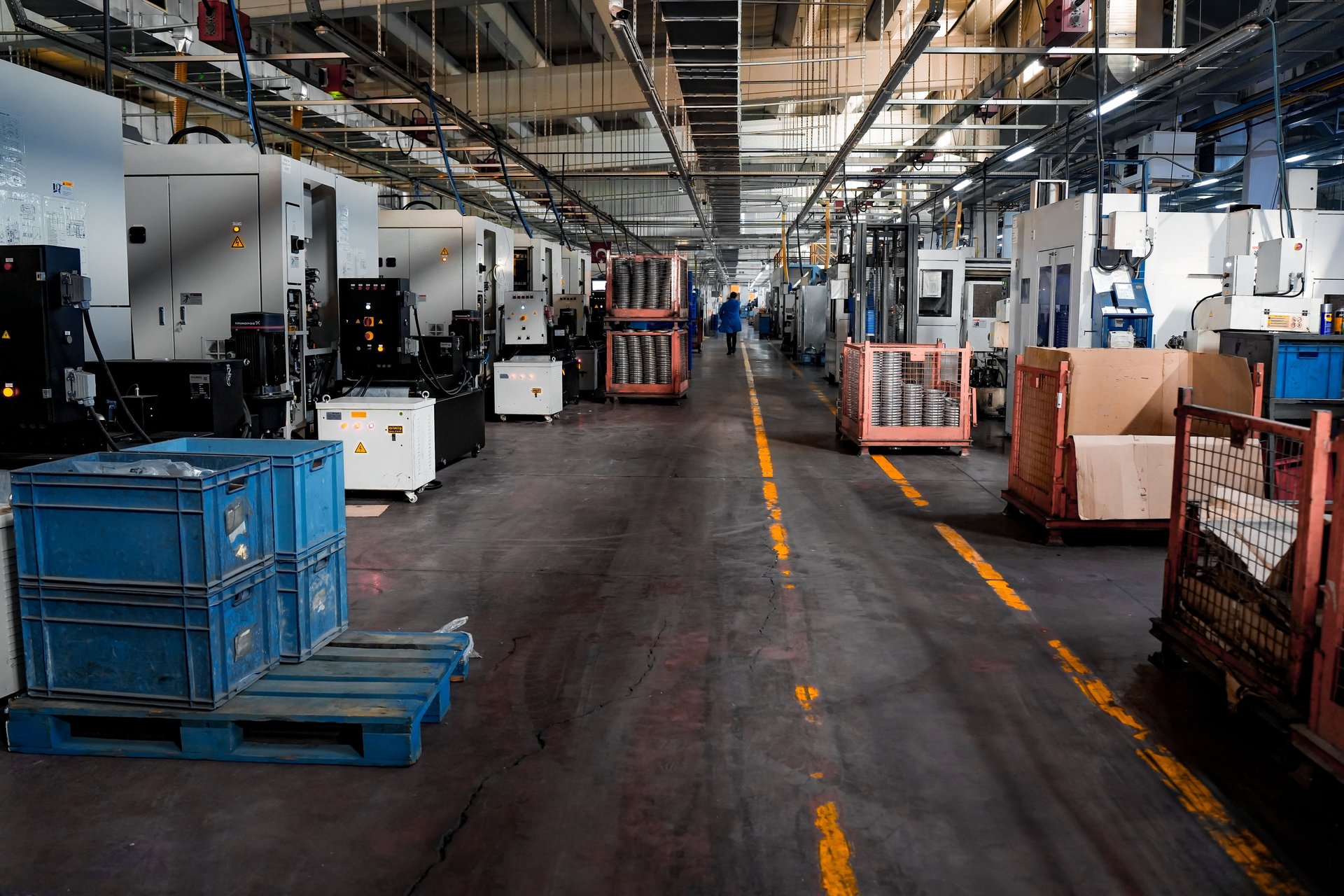
A production line running 10,000 parts per day at a 2% defect rate leaks 30 defective units a day to the customer with manual inspection at 85% accuracy — and only 4 with an AI camera at 98% [1]. The math comes from the Eastgate Software AI-in-manufacturing benchmark (2025) and shows up again in iFactory deployments: escape rate dropped from 2.3% to 0.1%, recovering USD 1.8M annually in warranty claims alone [2].
The global machine vision market reached USD 15.83 billion in 2025 and is projected at USD 23.63 billion by 2030 at an 8.3% CAGR [3]. The dominant segment is not security — it is inspection, which accounts for 42% of market share per Interact Analysis [4]. In Latin America and Mexico, the demand pull is coming from automotive Tier 1 suppliers and export electronics.
( for automotive tolerance lines, the accepted DPPM benchmark is <50; medical devices <10; discrete manufacturing averages 200-500 DPPM, and an honest plant moving from manual logging to MES capture sees DPPM rise 2-5x before it falls — because the old number was undercounted [5] )
One industrial camera, two jobs. The same camera that catches surface defects on the line also watches PPE (helmets, vests, eye protection) in high-risk zones and fires an alert in under a second when a worker enters a hot zone without a hard hat [11]. That is not a luxury — it is a shift in how the same capex earns back. Documented payback from iFactory and Sciotex runs 5.8 to 9 months, with a documented 374% three-year ROI per Forrester research cited by Sciotex [9][10].
The minimum hardware spec a plant demands: camera housing with IP66/IP67 (IEC 60529) for dust + powerful water jets or temporary immersion, and IK10 (IEC 62262) wherever the camera is reachable by an operator or forklift — IK10 absorbs 20 joules, roughly a 5 kg mass dropped from 40 cm [6][7]. Without those ratings, it is not an industrial camera — it is an office camera that will last six months on the plant floor.
One number many deployments ignore: the published 98-99% accuracy figure applies to controlled conditions. In a real plant — dust, vibration, lighting drift — a reasonable conservative target is 95-97% in the first 3-6 months, climbing toward 98%+ after optimization [1]. Anyone promising 99% on day one without a lighting audit and Gauge R&R is selling, not integrating.
Every time I review a plant deployment for tv4agent, the metric that separates a useful system from an expensive decoration is not resolution or FPS. It is minutes between the defect and the corrective action on the line. If your AI vision fires 50 alerts a day and the operator takes four hours to react, you have an expensive data logger, not a quality system. What makes the investment pay is the closed loop: the camera does not just detect — it feeds the correction back to the cell in real time (automated reject, guided rework, process parameter adjustment) [1][4].
P.D. How many parts per million do you produce, how many escape to the customer, and how many minutes does your team take to react to a quality alert? If the answer is “we don’t track that” or “more than 30 minutes”, today is a good day to revisit your QC stack.
📰 Source: Eastgate Software 2025 + SmartDev 2025 + MarketsandMarkets 2025-2030 + iFactory 2026 case studies + Symestic DPPM benchmarks + IEC 60529 / IEC 62262 standards via SCVS + SourceBySpec + Tapway 2026 + Sciotex ROI analysis + GlobalSpec 2025 (Gartner forecast) + FlowLinks PPE detection.
📌 Executive summary (1 minute)
| Item | Value |
|---|---|
| Machine vision market size 2030 | $20B USD (MarketsandMarkets) |
| 2025-2030 CAGR | 14.3% |
| Modern industrial CV accuracy | 98%+ (Eastgate 2025) |
| Typical DPPM reduction with CV | 50-80% |
| 4-camera + edge AI system CAPEX | $8,000-12,000 USD |
| Typical ROI | 8-14 months |
| Minimum plant IEC rating | IP66 + IK10 |
| Action #1 this week | Measure current DPPM by production line |
Frequently asked questions
What accuracy does modern industrial CV have? 98%+ in controlled conditions (consistent lighting, fixed angle, trained defect library). In variable conditions (plant with shadows, vibration, dust), drops to 92-95%. Vendors publish 99.5% in marketing; on the actual line, typically 95-97%. The difference is the cost of the training dataset.
What if I have a small line (10-30 parts/min)? Small lines have the highest ROI. A system of 4 cameras + edge AI costs $8-12K USD and replaces 1 human inspector ($2-3K USD/month in LATAM). Payback: 3-4 months. For large lines (>100 parts/min), the ROI is still good but takes 8-12 months.
Does it work with any product type? Yes, but the initial setup varies. Metals and glass: easier, high contrast. Plastics and textiles: medium, requires more light. Food and pharma: harder, requires special cameras + specific lighting. The metals benchmark is 99.5% accuracy; in food it’s 92-95%. The reason: natural variation in the product.
What about operator privacy? Quality CV does NOT use facial recognition or biometrics. It analyzes the PRODUCT, not the person. Zero privacy impact. This is an important difference vs security CV: in quality, cameras point at the product, not at the operator. LFPDPPP compliance does not apply (no personal data captured).
What about industry certifications (ISO 9001, IATF 16949)? Industrial CV replaces human inspection at the points where it’s applied, not the certifications. ISO 9001 and IATF 16949 are about process, not tool. What changes: the audit now verifies the CV system is calibrated, DPPM data is reliable, and operator override has traceability.
How much does maintaining the system cost after the first year? $200-500 USD/month for a 4-8 camera system: edge AI maintenance, model retraining (when there are new defects), software licenses, vendor support. That’s ~5% of CAPEX annually. Without this maintenance, accuracy drops 1-2% per quarter.
Sources
[1] Eastgate Software — Computer Vision Industrial Quality Control: 98%+ Accuracy Guide (2025) — https://eastgate-software.com/insights/computer-vision-industrial-quality-control/ [2] SmartDev — How to Build Computer Vision Systems for Manufacturing Quality Control (Nov 2025) — https://smartdev.com/ai-computer-vision-manufacturing-quality-control/ [3] MarketsandMarkets — Machine Vision Market Size, Share & Trends 2025-2030 — https://www.marketsandmarkets.com/Market-Reports/industrial-machine-vision-market-234246734.html [4] iFactory — AI Vision Inspection for Manufacturing: Automated Defect Detection Guide 2026 — https://ifactoryapp.com/article/ai-vision-inspection-manufacturing-defect-detection [5] Symestic — DPPM: Definition, Formula & Benchmarks 2026 — https://www.symestic.com/en-us/what-is/defect-parts-per-million [6] SCVS — What IP66/67 and IK10 Ratings Actually Mean for an Outdoor Camera Deployment — https://www.scvs.com/blogs/posts/what-ip66-67-and-ik10-ratings-actually-mean-for-an-outdoor-camera-deployment [7] SourceBySpec — Industrial Surveillance Cameras Guide (IEC 62676 / 60529 / 62262 / 60079) — https://www.sourcebyspec.com/encyclopedia/surveillance-camera.html [8] Tapway — The Measurable ROI of AI Vision for Manufacturing Quality Inspection in 2026 — https://gotapway.com/blogs/the-measurable-roi-of-ai-vision-for-manufacturing-quality-inspection-in-2026 [9] Sciotex — Machine Vision Systems ROI: How to Build the Business Case — https://sciotex.com/machine-vision-systems-roi-build-your-business-case/ [10] Electronics360 / GlobalSpec — Outlook 2025: The rise of AI-enabled machine vision (Gartner forecast) — https://electronics360.globalspec.com/article/21772/outlook-2025-the-rise-of-ai-enabled-machine-vision [11] FlowLinks — AI Helmet Detection for Manufacturing (real-time PPE monitoring) — https://www.flowlinks.ai/manufacturing/helmet-detection