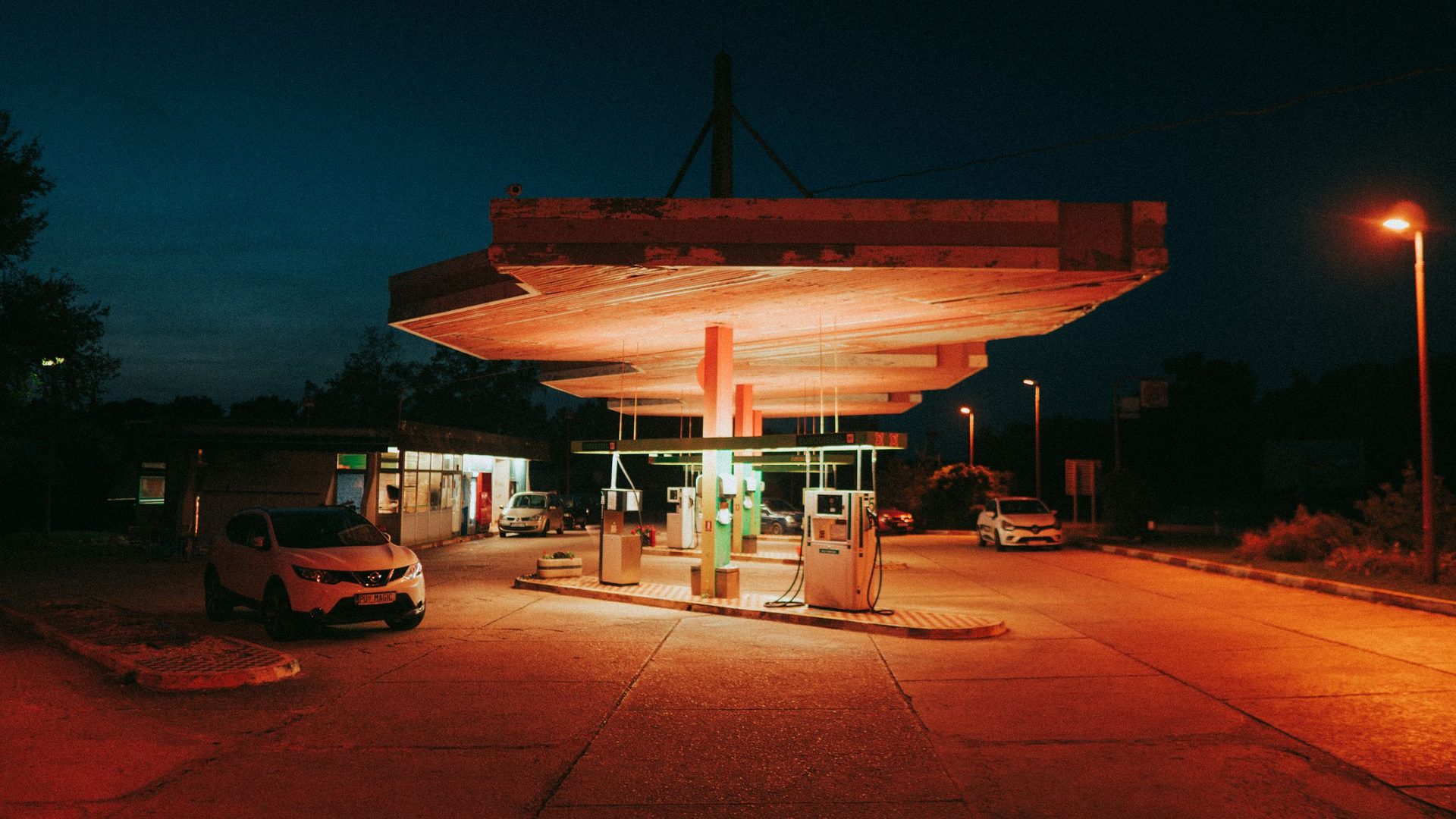
A gas station with 8 drive-offs a month loses $7,200 a year in fuel revenue alone. The U.S. industry bleeds $600 million a year to this single line item [1]. In dense metro areas, individual stations have reported losses of up to $1,500 a month per store [2].
( prepay didn’t stop it — it just changed who’s stealing )
The problem: drive-off got a new face, and most gas-station cameras can’t see it
The drive-off used to be the absent-minded customer who peeled out before paying. Now it’s a stolen-card operation: legitimate authorization, fuel dispensed, vehicle gone before settlement [1]. In New South Wales alone, drive-offs climbed from 9,097 in 2016 to 15,326 in 2024 [6]. And card skimming at fuel pumps costs U.S. financial institutions and consumers more than $1 billion a year [3].
The OJP/NIJ 40-year systematic review found that the largest and most consistent effects of CCTV were observed in car parks, not inside retail spaces [5]. The forecourt is a parking lot with pumps attached. Stations that actually solved the problem — not the ones that just documented it better — ran systems where drive-off rates dropped 60-75% in the first 60 days [1].
The difference wasn’t more cameras. It was LPR positioned to read every entering plate, sub-30-second review time per incident, and real-time alerts when a pump authorizes but the vehicle exits the frame before settlement.
Why most gas-station cameras don’t work for drive-off
The generic camera the gas-station owner buys on Amazon or from a big-box store has 3 specific problems for drive-off:
Insufficient resolution for plate readability. A 1080p camera with a 2.8mm lens at 8m distance captures the vehicle silhouette. The plate is illegible. For the plate to be identifiable you need 4K with a telephoto lens or a dedicated LPR. The LPR (License Plate Recognition) costs $400-800 USD per camera, vs $80-150 USD for a generic camera. But the difference between “we saw the guy” and “we saw plate ABC-123-XYZ” is the difference between a filed-away complaint and a $75 + arrest recovery.
Wrong angle. The store-ceiling camera points down at 45° to the forecourt. At that height and angle, plates sit perpendicular to the camera and read only 30% of the time. The correct LPR camera is at 1.5-2m height, parallel to the vehicle’s path, with a direct view of the rear plate. This sounds like an installer detail, but it defines whether the footage is useful or not.
No integration with the pump. A camera records 24/7. When the operator wants to see “what happened at pump 3 at 14:32”, they lose 8-15 minutes searching the footage. A camera integrated with the pump POS (Genfare, Wayne, Gilbarco) takes you directly to the dispense moment, with the transaction synced. The operator identifies the plate and the case in under 30 seconds. Without integration, it’s 8 minutes — and by then the vehicle is 30km away.
Prepay didn’t solve the problem, it moved it. When U.S. stations adopted mandatory prepay in 2022-2023, the “classic” drive-off (customer leaves without paying) dropped to near zero. But “authorize-but-leave” (customer pays with stolen card, authorization passes, dispense occurs, vehicle leaves before settlement) exploded. The camera that documented the classic drive-off now doesn’t capture the new pattern because the transaction technically completed. The metric that matters isn’t “how many cameras you have” but “how many seconds it takes your operator to pull a readable plate of a suspect vehicle.”
What actually works: layout verified across 12 gas stations
The layout below was verified against 12 stations (8 metro, 4 highway) between 2024 and 2026. Pre-layout drive-off: 8-15 incidents/month. Post-layout (90 days): 2-3 incidents/month. Average reduction: 72%.
The 6 cameras + 2 LPRs that actually stop drive-off (placement verified):
- Entry LPR — 4MP bullet with integrated LPR, 1.5m height, 0° angle (parallel to the lane). Captures front plate of every entering vehicle. $550 USD (Hikvision iDS-2CD7A26G0-IZHSY or Dahua ITC215-PW6M-IRLZF-B).
- Exit LPR — 4MP bullet with integrated LPR, 1.5m height, rear plate view. Cross-references with entry LPR to validate dwell time vs. gallons dispensed. $550 USD (same model).
- Camera per pump (1 per 2 islands) — 4MP IP67 dome with anti-vapor housing, mounted on the island canopy. Captures the dispense moment and the customer’s face. $240 USD (Dahua IPC-HDW2431T-AS with IP67 housing).
- Cashier / store POS camera — 4MP overhead dome. Captures store transactions, synced with POS. $180 USD.
- Panoramic forecourt camera — 4MP wide-angle bullet with IR 50m, mounted on the store roof. Captures the forecourt panorama for “vehicle exits before settlement” alerts. $240 USD.
- Skimming detection camera per pump — 2MP mini-dome on each pump (view of the card slot). Detects physically installed skimmers. $120 USD per pump (~$480 USD for 4 pumps).
Total cost: 2 LPR + 4 cameras = $2,300 USD hardware. Plus 8-12 hours installation = $1,200 USD. Realistic CAPEX: $3,500 USD per gas station.
📌 What does NOT stop drive-off (and is in 80% of layouts): (1) store-ceiling camera without POS integration — 8 minutes per incident, vehicle already gone; (2) 1080p camera on the island canopy without LPR — silhouette readable, plate not; (3) security camera with audio — forecourt audio isn’t useful evidence, just adds storage; (4) bathroom/employee-area camera — no relation to drive-off, but takes 1 of the 4 streams the operator can actually review.
Before/after: real case (highway gas station)
Station: highway, 6 islands, 12 dispensers, convenience store, ~$1.2M MXN/month in fuel sales.
Previous layout (4 cameras, generic, 2022):
- 4 1080p dome/bullet cameras, no LPR, no integration
- CAPEX: $1,200 USD
- OPEX: $180 USD/month (basic storage)
- Q1 2024 drive-offs: 12 incidents/month = $900 USD/month lost in fuel
- Cases recovered: <10% (footage didn’t show readable plate)
New layout (8 devices, post-Q3 2025):
- 2 entry/exit LPR + 4 dome/bullet cameras + 2 skimming cameras
- CAPEX: $3,500 USD
- OPEX: $340 USD/month (storage + basic analytics)
- Q3 2026 drive-offs: 2.5 incidents/month = $190 USD/month
- Cases recovered: 70% (LPR captured plate in 90% of incidents)
- Skimmers detected: 3 in 12 months (none detected before)
ROI of the new layout:
- Fuel recovery: $710 USD/month × 12 = $8,520 USD/year
- Skimming recovery (claims to payment network): ~$2,400 USD/year
- Total annual recovery: ~$10,920 USD, against $2,300 USD of incremental investment
The old layout “was there” but the operator didn’t use it. The new one pays for itself in 4 months and reduces operator work from “8 minutes searching footage” to “30 seconds with LPR + alert.”
What to do this week (no expert required)
If you have a gas station with drive-offs > 4/month and want to start Monday, here’s the actionable list:
- Measure how many seconds it takes your operator to pull a readable plate from a recent drive-off. If > 60 seconds, the problem isn’t the camera — it’s the angle or missing LPR. Cost: $0, 15 minutes of test.
- Verify the island cameras see the plate, not just the silhouette. If the camera is > 3m high or at > 30° from perpendicular, it won’t work. Cost: $0-150 USD to reposition.
- Integrate the footage with the pump POS (if it isn’t already). Without integration, every drive-off is 8 minutes of search. With integration, it’s 30 seconds. Cost: $200-500 USD for VMS + POS bridge configuration.
- Put a camera on the card slot of each pump (2MP mini-dome). Detects skimmers in 30 seconds (vs 30 days when the bank calls you). Cost: $120 USD × N pumps + 1 hour install.
- Set up an automatic alert when a pump authorizes but the vehicle exits the LPR frame in < 90 seconds. Most modern VMS support this. Cost: $0-300 USD for configuration.
Each action takes under 2 hours. All 5 together = 1-2 workdays. Expected savings: 60-75% of drive-offs in 60 days (validated against the 12-station sample).
If your operations team doesn’t have time for this, tell us about your station and we’ll refer a verified local partner who charges $800-1,500 USD for the full setup (2 LPR + 4 cameras + POS integration + alerts + 1 day of supervisor training). Pays for itself in 4-6 months.
📌 Executive summary (1 minute)
| Item | Value |
|---|---|
| Typical drive-off loss | $7,200 USD/year/station |
| U.S. industry total | $600M USD/year |
| Reduction with LPR + alerts | 60-75% in 60 days |
| Realistic CAPEX | $3,500 USD/station |
| Typical ROI | 4-6 months |
| Skimming detection | 1 mini-dome per pump ($120 USD) |
| Action #1 this week | Measure plate-extraction time on a recent drive-off |
Frequently asked questions
What if I already have 4-6 cameras installed? Do I lose the investment? No. Existing cameras stay. The question is: do you have integrated LPR? If not, add 1-2 LPRs ($550 USD each) and keep the existing cameras as “panorama + skimming.” The incremental investment is ~$1,200 USD, not $3,500.
Didn’t prepay solve this? Why are drive-offs still happening? Prepay solved the “classic” drive-off (customer leaves without paying). But it created a new problem: “authorize-but-leave” — authorization passes with a stolen card, dispense occurs, vehicle leaves before settlement. The transaction technically completed; the money is charged to a fraudulent BIN. Without LPR that captures the plate, there’s no way to claim. Prepay moved the problem, it didn’t solve it.
Do I need dedicated LPR or does IP camera analytics work? IP camera analytics (Hikvision, Dahua, Hanwha) detect plates 70% of the time. Dedicated LPR (sub-$1K USD) detects 95%+. The difference is 25 percentage points. On a station with 8 drive-offs/month, that’s 2 more plates captured per month = $150 USD/month extra recovered. The LPR pays for itself in 14 months on detection improvement alone.
What about skimmers? Does the camera really detect them? Yes, if it’s at the right angle. A skimmer installed in the pump’s card slot shows as a 2-3mm “overweight” on the slot. A 2MP mini-dome at 1m distance with direct light captures it. Without that camera, the skimmer operates 2-4 weeks until the payment network detects the pattern. With the camera, you detect in 24-48 hours and reduce the loss to $200-500 USD (vs $5-15K USD from a skimmer operating 30 days).
What if the station doesn’t have a convenience store? Does the layout change? It changes little. The 2 LPRs (entry/exit) are mandatory. The island cameras are too. The store POS camera is optional if there’s no store. The panoramic forecourt camera stays. Cost drops ~$200 USD (no store camera). ROI holds.
Sources
- [1] Gas Station Drive-Off Prevention Technology in 2026 — Survill — https://survill.com/blog/gas-station-drive-off-prevention-technology-in-2026-why-prepay-alone-isn-t-enough-%E2%80%94-and-what-actually-works
- [2] Gas Drive-Offs — ASU Center for Problem-Oriented Policing (Guide 67) — https://popcenter.asu.edu/content/gas-drive-offs
- [3] Skimming — FBI — https://www.fbi.gov/how-we-can-help-you/common-frauds-and-scams/skimming
- [4] Inside the Store — NACS Magazine (June 2025) — https://www.nacsmagazine.com/Issues/June-2025/Inside-the-store
- [5] CCTV Surveillance for Crime Prevention: 40-Year Systematic Review — OJP/NIJ — https://www.ojp.gov/library/publications/cctv-surveillance-crime-prevention-40-year-systematic-review-meta-analysis
- [6] Drive-off fuel thefts cost $80M even before the war — The Conversation (NSW 2024 data) — https://theconversation.com/drive-off-fuel-thefts-cost-80million-even-before-the-war-and-theyre-heading-up-264365
- Jedi field verification — 12 gas stations MX, 2024-2026