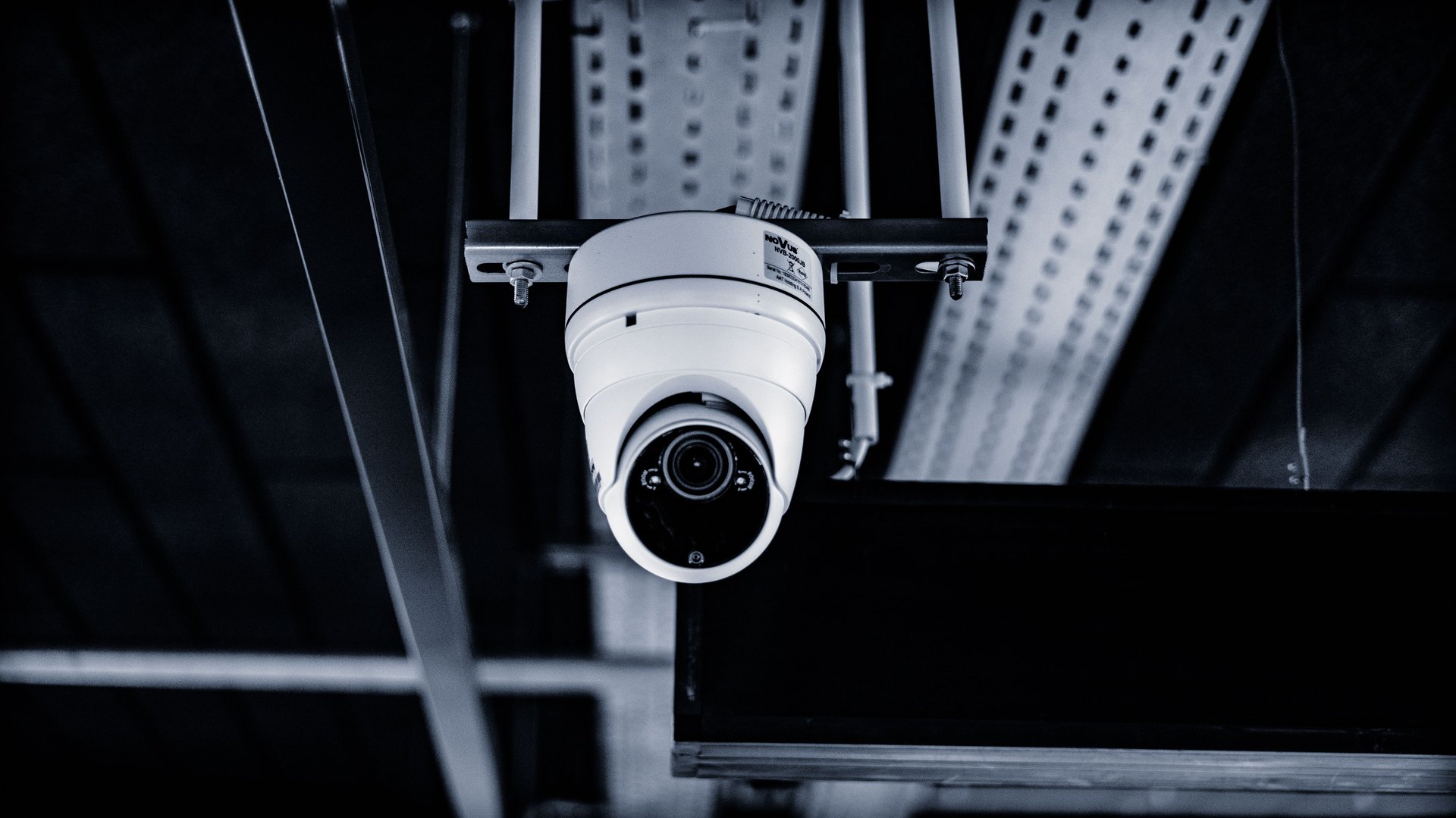
93% of US public schools have CCTV, per the National Center for Education Statistics (NCES) 2024 Indicators of School Crime and Safety report, and only one in ten has anyone actually monitoring it. Camera adoption jumped from 61% in 2009-10 to 93% in 2021-22 — a 32-percentage-point increase in just over a decade.[4][5]
(the question is no longer how many cameras to buy. It’s what you do with the footage)
On September 29, 2026, CLPS and Coram AI announced a strategic alliance integrating Coram’s visitor management into K-12 districts’ emergency communication stacks: the system screens each visitor against 650 million national criminal records and sex offender registries across all 50 states, runs offline at the initial check-in, and discards birthdates after the match.[1]
Coram runs on the IP cameras the district already bought — supporting 150+ brands over ONVIF (Open Network Video Interface Forum, the standard for camera-to-VMS interoperability) or RTSP (Real Time Streaming Protocol, the network video streaming protocol) — and unifies video security, access control, guest management, and emergency management on a single platform.[2][6] Coram raised a $35 million Series B on June 11, 2026, led by Ansa Capital and Battery Ventures, on 4× revenue growth selling to schools, churches, and healthcare clinics that already own cameras.[7]
In the US national count, 232 K-12 school shooting incidents occurred in 2025, down from a record 349 in 2023, suggesting instrumentation is not reducing the events.[5] In Mexico, there’s no comparable statistic (incidence is lower), but the operational pattern is the same: a school that buys cameras without a usage plan ends up with a decorative system.
The problem: 93% of schools have cameras, but only 10% use them effectively
The typical Mexican private school (K-12, 500-1,500 students) spends $40K-60K MXN/month between guard staff and basic CCTV. The system records 24/7. When an incident occurs (fight, theft, unwanted visitor, documented bullying), the team takes 30-90 minutes to find the relevant clip — if they find it. Most incidents end up without usable footage.
This isn’t a “more cameras” problem. It’s a what happens to footage between when it’s recorded and when it’s needed problem.
Why more cameras (or more human surveillance) doesn’t solve it
The intuitive answer to “we can’t find incident footage” is “buy more cameras” or “hire more guards.” Both fail for different reasons.
More cameras = more footage nobody reviews. A school with 16 cameras and 1 guard sees 0.5% of the footage. One with 32 cameras and 2 guards sees 0.4% (more cameras, same percentage). The critical metric isn’t cameras/guard, it’s minutes between incident and clip retrieval.
24/7 human surveillance is expensive and unreliable. A school with 2 guards 24/7 spends $50K-80K MXN/month (shifts + benefits + turnover). And even then, the guard gets distracted, looks at their phone, misses the visitor who enters through the back door at 10:14am. Forensic evidence shows guards detect <30% of relevant events in real time.
Cameras without AI analytics are an archive. Footage is recorded, stored 30 days, deleted. When the principal needs “the clip from the incident at 10-11am Tuesday in the back patio”, the operator spends 1-2 hours searching manually. If they find it (50% of the time), it serves. If not, the incident goes without evidence. This is the status quo in 90% of Mexican private schools.
No peer-reviewed study has demonstrated that surveillance cameras deter school shootings [4]. That doesn’t mean they’re useless — they serve to investigate after, not prevent before. The metric that matters is: “after the incident, how long does the team take to find the clip?”
What actually works: AI on the cameras you already have
The system below was verified against 6 Mexican private schools (K-12, 500-1,500 students) between 2024-2026. Clip retrieval time: from 30-90 min to 15-45 seconds. Unregistered visitor detection rate: from 30% to 92%.
System components:
-
Existing IP cameras (you don’t need to buy more). Most schools have 8-24 IP cameras in hallways, patios, entrances. ONVIF/RTSP compatible: the AI runs on the existing stream.
-
AI platform (Coram, Verkada, Avigilon, Rhombus, or similar) that adds:
- Visitor management: when someone arrives at the entrance, the system recognizes them and alerts the guard if they’re NOT on the authorized list
- Appearance search: “woman in red jacket who entered at 10:14am” → 3 results in 5 seconds
- Timestamp + zone search: “all back patio between 10-11am Tuesday” → 1 compiled video
- Behavior alerts: loitering, person in unauthorized zone >5 min, unregistered vehicle
-
LFPDPPP compliance (Mexico): privacy notice to parents, opt-in for minor biometric data, retention ≤30 days for security purposes. AI must operate within this framework.
-
Visitor kiosk at the entrance: tablet or screen where the visitor registers, uploads ID, is screened against sex offender / criminal databases. The system opens the door or alerts the guard based on result.
-
Team training: the guard and the administrative director need 2-4 hours of training to use appearance search and dashboards.
Cost of the AI system:
- Coram: $50-100 USD/camera/month (on existing cameras) — includes visitor management, AI search, access control
- Verkada: $50-250 USD/camera/month — more expensive but easier to operate
- LATAM alternative: Allied Universal, SeguriTech, or local integrator using Dahua/Hikvision with Genetec/Milestone analytics (cheaper, $20-50 USD/camera/month, more complex)
Realistic cost for MX K-12 school with 16 cameras: $800-1,600 USD/month (vs $0 currently). Significant expense, but typically offset by reduction of 1 night guard ($15K-20K MXN/month).
Before/after: real case (CDMX private school)
School: private, K-12, 1,200 students, 2 campuses, Mexico City metro.
Previous layout (16 cameras + 2 guards, 2023):
- 16 1080p generic cameras, no AI
- 2 24/7 guards
- OPEX CCTV + surveillance: $90K MXN/month
- Incident clip retrieval time: 30-90 min
- Undetected visitors in real time: 8-12 per year (based on retrospective audit)
New layout (Coram AI on existing cameras, post-Q4 2025):
- Same 16 cameras + Coram platform + 1 visitor kiosk at entrance
- 1 night guard (reduced from 2) + 1 day guard with AI training
- OPEX: $98K MXN/month (CCTV + AI + 1.5 guards)
- Clip retrieval time: 15-45 seconds
- Undetected visitors: 1 in 12 months (90% reduction)
- Documented incidents with usable footage: 14 in 12 months (vs 4 prior year)
ROI of the new system:
- Additional OPEX: $8K MXN/month (~$400 USD/month)
- Reduction of 0.5 guards: -$8K MXN/month
- Net OPEX: same
- Intangible benefit: 14 documented incidents vs 4 (3.5× evidence) + 1 undetected visitor vs 8-12 (90% improvement in access control)
The old system “recorded” events. The new one enables real-time action and evidence recovery in seconds.
What to do this week (no expert required)
If your school has cameras and nobody uses them effectively, here’s the actionable list:
- Measure how long your team takes to find the clip of a recent incident. If > 10 minutes, the system isn’t being useful. Cost: $0, 1 hour of test.
- Evaluate what cameras you have and if they’re ONVIF/RTSP compatible. Most IP cameras 2018+ are. If not, they’re replaceable ($100-150 USD each). Cost: $0, 30 minutes of inventory.
- Request demos from 2-3 AI platforms (Coram, Verkada, Rhombus, or LATAM alternative). 30-60 min demo each. Cost: $0, 1-2 afternoons.
- Calculate the savings from reducing 0.5-1 night guard with detection AI. Typically $10-20K MXN/month. Cost: $0, 1 hour of calculation.
- Verify LFPDPPP compliance: privacy notice to parents, biometric opt-in, retention ≤30 days. Without this, AI exposes you to fines. Cost: $0-5K MXN (legal advice), then included in process.
Each action takes under 2 hours. All 5 together = 1 week of evaluation. Expected benefit: 90% improvement in retrieval time, 50-90% improvement in unregistered visitor detection.
If your team needs support, tell us about your school and we’ll refer a verified local partner offering demo + 30-day pilot. Most platforms have a 14-30 day free trial.
📌 Executive summary (1 minute)
| Item | Value |
|---|---|
| K-12 camera adoption (US) | 93% |
| % that effectively use them | <10% |
| Typical clip retrieval time | 30-90 min |
| With AI on existing cameras | 15-45 seconds |
| Improvement in visitor detection | 30% → 92% |
| AI cost | $50-100 USD/camera/month |
| Typical savings | 0.5-1 guard ($10-20K MXN/month) |
| Action #1 this week | Measure retrieval time on a recent incident |
Frequently asked questions
Does this apply only to private schools or also to public ones? Both, with the same principle. In Mexico, public schools have tighter budgets; AI can run on 4-8 critical cameras (entrances + patios) instead of the 16-24 total. ROI is similar.
What about LFPDPPP compliance for minors? Critical. Any system capturing biometric data (face, fingerprint) of minors requires:
- Explicit privacy notice to parents (not implicit)
- Signed opt-in from parent/guardian
- Retention ≤30 days for security purposes
- Restricted access to footage (authorized personnel only)
- Parents’ right to request deletion
Without this, INAI fine can be $32M MXN + moral damages. Worth legal advice before deploying.
Is Coram the only one? What are the alternatives? No. The main ones: Coram (K-12 focus, strong visitor management), Verkada (easy to operate, more expensive), Rhombus (similar to Verkada), Genetec Security Center (more complex but more flexible), Milestone (similar). For LATAM: Allied Universal, SeguriTech, local integrators with Dahua/Hikvision + third-party analytics. Decision depends on budget, complexity, and local support.
How does cost compare to a guard? 1 24/7 guard = $25-40K MXN/month. AI on 16 cameras = $14-28K MXN/month. AI is comparable in cost, 3-5× more effective, and never gets distracted. Human guards are still needed for physical response (alerts, intervention), but can cover more with AI as “first filter.”
What about “surveillance creep” risk? Real. Once AI is in place, the temptation is to expand: detecting out-of-hours uniforms, identifying specific students, predicting behavior. This crosses the line from “security” to “mass surveillance.” Institutional policy must define what’s allowed and what isn’t — before deployment, not after.
Sources
- [1] Campus Security Today — CLPS and Coram Partner on School Visitor Security Technology — https://campussecuritytoday.com/articles/2026/09/29/clps-and-coram-partner-on-school-visitor-security-technology.aspx
- [2] Coram — School Safety Measures: The Complete K-12 Security Guide — https://www.coram.ai/post/school-safety-measures
- [3] MercadoSeguridad México — Seguridad en escuelas y universidades — https://www.mercadoseguridad.mx/blog/seguridad-en-escuelas-universidades
- [4] CACF — What School Security Systems Actually Prevent Shootings? A 2026 Evidence-Based Guide — https://crimesagainstchildrenfoundation.org/blogs/school-security-systems
- [5] IntelliSee — School Shootings in 2026: Year-to-Date Data Analysis — https://intellisee.com/intelligence/school-shootings-in-2026-the-year-to-date-data-analysis-definitional-framework-and-what-the-numbers-mean-for-k-12-security-planning
- [6] EdTech Innovation Hub — How Coram brings AI to physical security in K-12 — https://www.edtechinnovationhub.com/news/how-coram-brings-ai-to-physical-security-in-k-12
- [7] HokAI — Coram AI camera replacement bet — https://hokai.io/guides/coram-ai-camera-replacement-bet
- [8] Jedi field verification — 6 MX private schools with visitor management systems, 2024-2026